Table of Contents
Herbst appliance – a fixed functional appliance
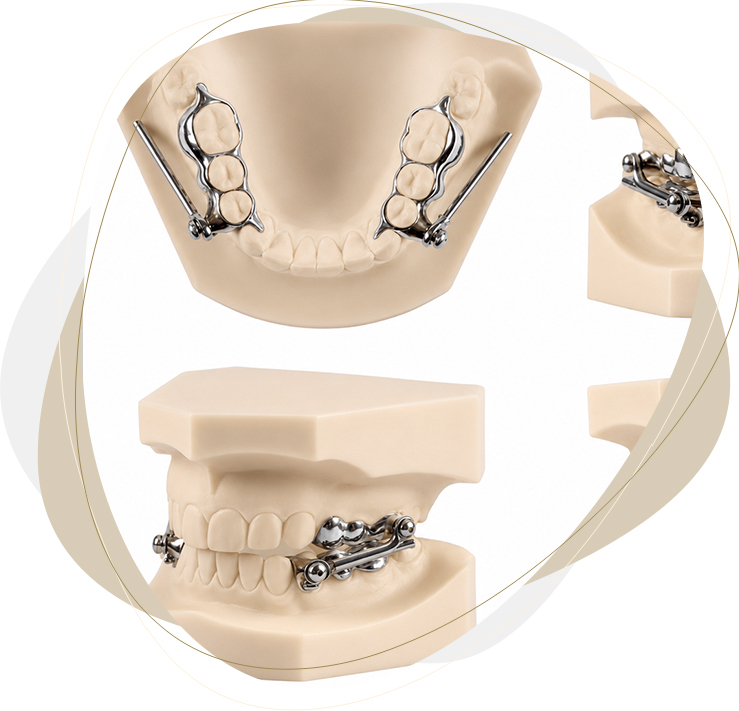
The Herbst appliance is a fixed, bimaxillary functional appliance used in the orthodontic treatment of Class II malocclusions. Its construction incorporates bilateral telescopic mechanisms connecting anchorage components in the upper and lower dental arches. The mechanisms allow the mouth to open while maintaining the mandible in the position prescribed by the clinician.
At KarDent, Herbst appliances are manufactured individually according to the clinician’s prescription and the submitted documentation. We offer appliances based on conventional orthodontic bands as well as constructions incorporating custom bands designed digitally and manufactured using SLM technology.
Herbst appliance design
The appliance consists of upper and lower components connected by a pair of telescopic mechanisms. Depending on the selected design, the construction may incorporate:
- conventional orthodontic bands,
- custom SLM bands,
- Herbst telescopes,
- tubes and pistons forming the telescopic mechanism,
- pivots or hinge attachments,
- reinforcing arches and arms,
- components connecting the bands within each arch,
- additional hooks, tubes or elements specified in the prescription.
The configuration of the metal components, the position of the telescopes and the method used to join the individual parts are adapted to the prescribed design. The laboratory does not alter the appliance version or the position of its main components without prior consultation with the clinician.
Herbst appliance with conventional bands
The conventional version is manufactured using appropriately selected prefabricated orthodontic bands. The bands are adapted to the abutment teeth on the working model and subsequently connected to the reinforcing arches, arms and telescope attachments.
The prescription should identify the teeth intended to receive bands, the required telescopic mechanism and any additional design elements. All components are prepared with reference to the relationship between the dental arches registered by the clinician.
Herbst appliance with custom SLM bands
The SLM version incorporates bands digitally designed for the individual case. Their geometry can be adapted to the tooth surfaces, the required extent of anchorage and the areas intended for connection to the telescopes and other appliance components.
The digital workflow allows the shape, thickness and margins of each band to be controlled during the CAD design stage. Once manufactured by selective laser melting, the components are processed, fitted and prepared for connection to the remaining appliance framework. The digital manufacture of customised Herbst components followed by laser welding is also described in specialist technical literature.
Custom SLM bands provide an alternative to prefabricated orthodontic bands. This does not mean that the entire appliance is manufactured as a single printed component. The SLM parts are assembled with the telescopes, arches and other elements prepared according to the design.
Bilateral telescopic mechanism
The bilateral telescopic mechanism is the characteristic component of the Herbst appliance. Its construction permits movement during opening and closing while maintaining the maxillomandibular relationship registered in the construction bite.
During fabrication, we check:
- the symmetry of the telescope positions,
- the alignment and configuration of the mechanisms,
- their unrestricted range of movement,
- the position of the pivots,
- the distance between the components and the soft tissues,
- the stability of the connections to the supporting framework.
The telescope type, length and position are determined by the prescription and the records submitted by the clinician.
Laser welding and appliance finishing
The metal components are laser-welded or, in selected areas, soldered depending on the appliance design and the type of components used. Laser welding allows localised connections to be created between the bands, arms and telescope attachments.
Once assembled, the appliance is finished and polished. Technical quality control includes checking adaptation to the working models, the continuity of the joints, the symmetry of the telescopic mechanisms, their freedom of movement and the surface finish.
Custom design options
The Herbst appliance may be customised in terms of:
- the type of bands,
- the number of teeth included in the anchorage,
- the configuration of the reinforcing arches,
- the type of telescopic mechanism,
- the position of the pivots and hinges,
- the incorporation of additional hooks or tubes,
- the connection between the upper and lower components,
- additional reinforcing elements.
For non-standard constructions, the design can be discussed with the laboratory before production begins. This allows the arrangement of the components and the technical feasibility of the appliance to be assessed in advance.
Manufacture based on models or scans
The Herbst appliance may be manufactured from accurate working models, impressions or intraoral scans. A correctly recorded relationship between the maxilla and mandible is also required.
The prescription should include:
- complete data for the upper and lower arches,
- a construction bite registration,
- identification of the abutment teeth,
- selection of conventional or SLM bands,
- the required telescopic mechanism,
- the prescribed configuration of the reinforcing components,
- information regarding any additional hooks, tubes or modifications.
Patient selection, mandibular positioning, appliance selection and clinical management remain the responsibility of the treating clinician. KarDent is responsible for the technical design and laboratory manufacture of the appliance in accordance with the submitted documentation.