Table of Contents
Orthodontic screws in custom-made appliances
Orthodontic screws are mechanical components used in a wide range of appliances manufactured by the laboratory. They may be embedded in the acrylic baseplates of removable appliances or incorporated into fixed appliances designed for maxillary expansion.
The function of a screw depends on the overall appliance design, including its position, activation axis, the configuration of cuts in the acrylic and the method of anchorage. Depending on the construction, screws may be used for transverse expansion, increasing arch length or moving a selected dental segment. Removable expansion plates are conventionally composed of an acrylic baseplate, an orthodontic screw and retentive components.
Types of orthodontic screws
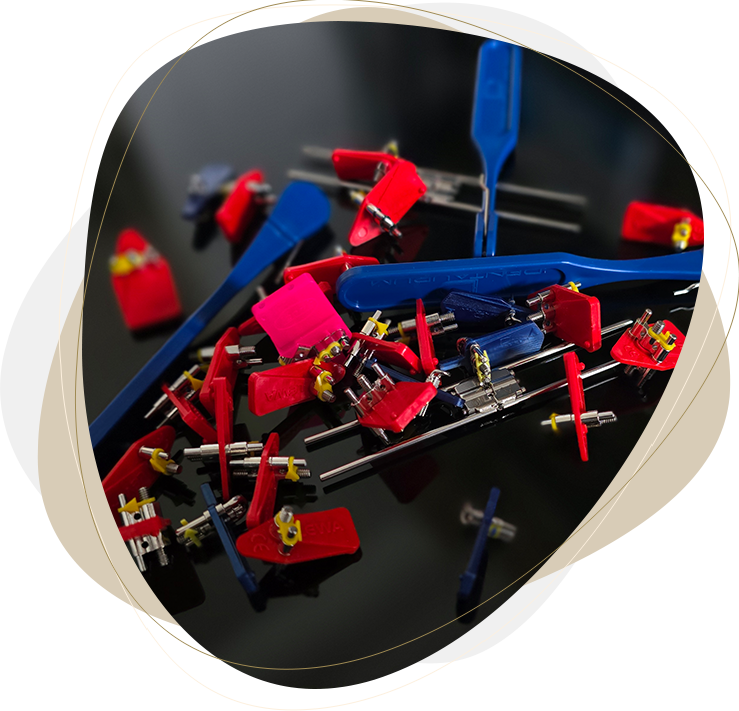
Depending on the appliance design, we use standard expansion screws, sector screws, fan-type screws and multidirectional screws.
Standard expansion screws may be used to develop the dental arch in the transverse or sagittal direction. Sector screws activate a selected part of the appliance, while fan-type screws enable different degrees of expansion in the anterior and posterior regions of the arch.
For appliances requiring simultaneous activation in several directions, multidirectional screws, including three-way screws, may be used. The specific component is selected according to the appliance design specified in the clinician’s prescription.
Screws used in RPE appliances
Expansion screws are also the central components of rapid maxillary expansion appliances, including Hyrax and Haas appliances and their modifications. Depending on the appliance type and method of anchorage, the screw may be connected to orthodontic bands, metal arms or acrylic components.
RPE appliances are described in greater detail in the heavy-wire and soldered appliances category. Here, they are presented as one of the appliance groups incorporating specialised orthodontic expansion screws. Hyrax and Haas are established designs used for rapid maxillary expansion.
Selecting the appropriate screw for the appliance
Screw selection should take into account its dimensions, working range, direction of activation and the space available within the appliance. The position of the wire components, the extent of the acrylic baseplate and the intended division of the appliance into active segments are also important.
At KarDent, the component is selected according to the clinician’s prescription and the technical requirements of the specific design. We do not change the screw type or its direction of action without prior consultation.
Precise positioning of the screw
Accurate appliance manufacture requires precise alignment of the screw axis and correct positioning of the activation cuts. The component must be securely embedded in the acrylic or connected to the metal framework in accordance with the prescribed design.
During production, we check the screw position, freedom of activation, symmetry of the appliance and the finish of the surrounding surfaces. Each appliance is supplied with a key suitable for the screw used, where required for the specific product.
Manufacture based on models or scans
Appliances incorporating orthodontic screws are manufactured from impressions, working models or intraoral scans. In a digital workflow, working models are produced using 3D printing technology.
The prescription should specify the appliance type, the intended direction of screw activation, the planned configuration of the acrylic cuts and any additional design requirements. Appliance selection, clinical indications and the activation protocol remain the responsibility of the treating clinician.